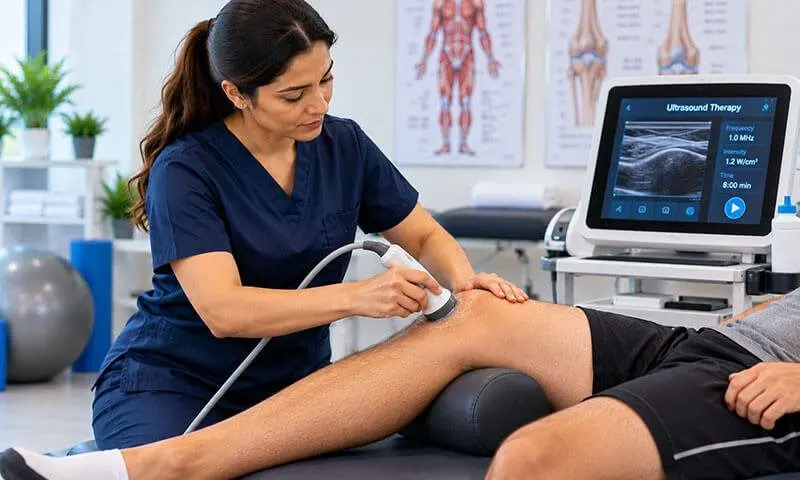
Therapeutic ultrasound uses high-frequency sound waves, delivered through a small probe and gel, to gently warm deep soft tissue. We use it to help relax muscles and ligaments before stretching, manual therapy and exercise.
Not the same as an ultrasound scan
The ultrasound used in physiotherapy is different from the scan used to look inside the body. The therapeutic version delivers sound energy into the tissue rather than creating a picture. Depending on the setting, it can produce gentle deep warmth or very small mechanical effects in the tissue.
Why we use it
Warmed tissue tends to be more flexible and less sensitive. A few minutes of ultrasound before stretching or mobilising a stiff shoulder, ankle or knee can make the hands-on and exercise part of the session easier and more comfortable. The research on ultrasound alone is mixed, which is exactly why we never use it in isolation.
Common uses at our clinic
- Ligament sprains after the first few days
- Muscle tightness and trigger points
- Stiffness around a joint, such as frozen shoulder
- Tendon irritation in the elbow, shoulder or heel
- Scar tissue after injury or surgery (once healed)
The session
A water-based gel is applied to the skin and the therapist moves the probe in slow circles for about five to eight minutes. You may feel slight warmth or nothing at all. It should never feel hot or painful – tell us straight away if it does.
When it is avoided
- Over the abdomen or lower back in pregnancy
- Over a cancer, active infection or a recent blood clot
- Over the eyes, the heart area or a pacemaker
- Over areas with poor sensation
- Over growing bone areas in children
How ultrasound fits into a session
A typical session might start with a few minutes of ultrasound over a stiff ankle ligament or tight shoulder, followed straight away by joint mobilisation and stretching while the tissue is warm, and finish with strengthening exercises. Used this way, ultrasound supports the active parts of treatment rather than replacing them.
Common questions about the gel and the probe
The gel is water-based, safe on skin and wipes off easily. The probe is kept moving at all times to avoid hot spots. You should never feel heat building up or discomfort – if you do, tell the therapist so the settings can be changed.
How many sessions?
Ultrasound is usually used for a limited number of sessions – often six to ten – during the early and middle stages of rehabilitation, then stopped as you become more active.
Ultrasound Therapy: questions patients ask us
Is therapeutic ultrasound the same as an ultrasound scan?
No. A scan creates an image; therapeutic ultrasound delivers gentle energy into tissue to warm and relax it.
Will I feel anything?
Usually just the cool gel and sometimes mild warmth. It should never be painful.
How long does it take?
Around five to eight minutes per area, as part of a longer session.
Does ultrasound therapy heal injuries by itself?
Evidence for ultrasound on its own is limited. We use it to prepare tissue for manual therapy and exercise, which do most of the work.
Can ultrasound therapy be used during pregnancy?
Not over the abdomen, pelvis or lower back. It may be used on other areas such as a wrist or ankle if appropriate.

Reviewed by Dr. Varun Duggal – Chiropractor, Osteopath and Physiotherapist (MPT Ortho), Kirti Nagar, New Delhi.
Last updated: