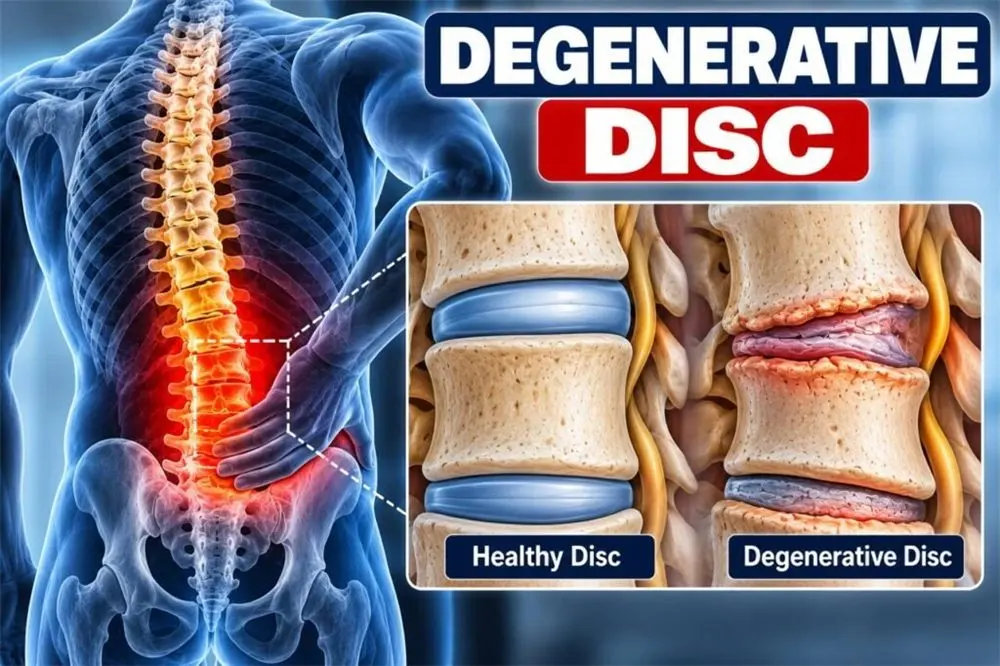
Degenerative disc disease describes discs that have lost height and hydration over time, which can lead to stiffness and recurring back or neck pain. Despite its name, it is not a progressive “disease” in the usual sense. Mobility work, decompression and strength training help most people stay active with less pain.
A misleading name
Hearing “degenerative disease” on an MRI report can be frightening. In reality, it describes changes that happen to almost everyone’s discs with age – a bit like grey hair for the spine. Some people with significant changes have no pain, while others with mild changes do. Pain depends more on how the spine is moving, how strong the supporting muscles are, and how sensitive the area has become.
Typical symptoms
- Ongoing low-level back or neck ache with occasional flare-ups
- Pain worse with prolonged sitting, bending or lifting
- Relief when walking or changing position
- Stiffness in the morning
- Sometimes leg or arm symptoms if a nerve is narrowed
What helps
The disc itself has a limited blood supply, so we focus on what we can change: the movement of the joints around it, the strength of the muscles that support it, and your overall activity levels.
- Mobilisation of stiff segments to spread movement more evenly.
- Spinal decompression for flare-ups or nerve irritation.
- Soft-tissue therapy for protective muscle tension.
- Graded exercise – core control, hip strength, walking programmes.
- Pacing advice so you can stay active without triggering flare-ups.
Flare-ups happen – here’s what to do
Even with good management, occasional flares are normal. Keep moving gently, use heat for muscle spasm, shorten sitting periods and return to your basic exercises. If a flare does not settle within a week or two, a few treatment sessions usually get you back on track.
See a doctor promptly if you develop leg weakness, numbness around the groin, bladder changes, fever or unexplained weight loss.
Degenerative Disc: questions patients ask us
Will degenerative disc disease get worse?
Disc changes may progress slowly, but pain often improves over time, and many people have less pain in their 60s than in their 40s.
Can exercise help degenerated discs?
Yes. Regular movement and strength training support the spine and are among the most effective treatments for pain.
Is spinal decompression useful for degenerative discs?
It can ease pain and nerve symptoms during flare-ups, as part of a wider programme.
Should I avoid bending forward?
Not completely. We teach you how to bend safely and build up tolerance gradually.
Will I need surgery?
Very few people do. Surgery is considered only for severe nerve compression or pain that does not respond to extended good treatment.

Reviewed by Dr. Varun Duggal – Chiropractor, Osteopath and Physiotherapist (MPT Ortho), Kirti Nagar, New Delhi.
Last updated: