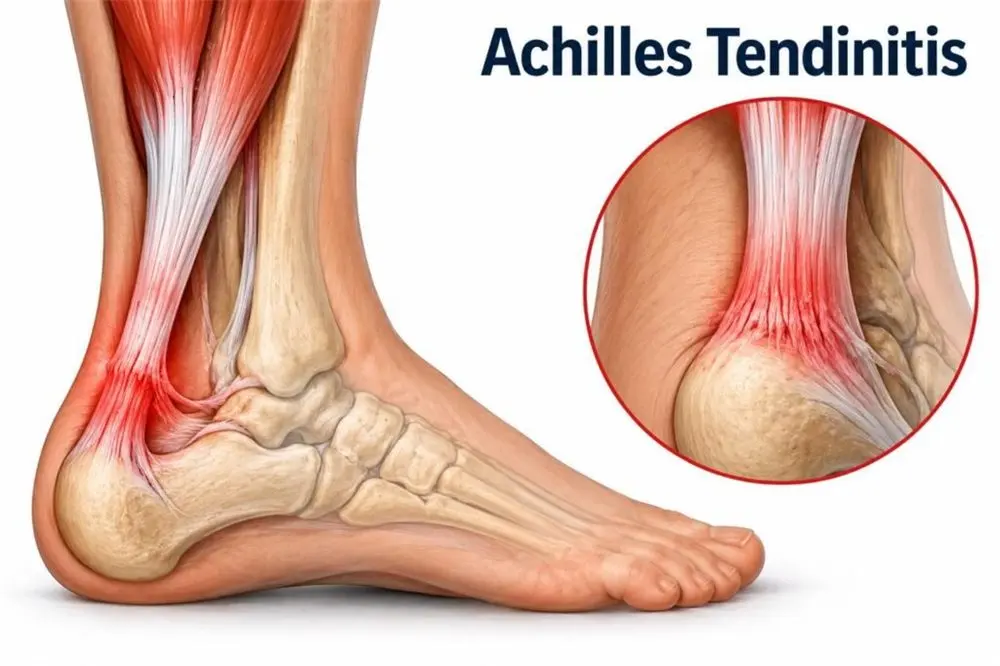
Achilles tendinitis (tendinopathy) is pain and stiffness in the tendon at the back of the ankle, usually from overload in running, walking or jumping. Morning stiffness is typical. A progressive calf-strengthening programme is the main treatment, with shockwave therapy for persistent cases.
Two locations, slightly different treatment
- Mid-portion – 2–6 cm above the heel; common in runners.
- Insertional – where the tendon attaches to the heel bone; often with a bony bump. Stretching over a step can aggravate this type.
Symptoms
- Pain and stiffness at the back of the ankle in the morning or after rest
- Pain at the start of activity that may ease, then return
- Thickening or tenderness of the tendon
A sudden snap, as if kicked in the back of the ankle, with difficulty walking may be an Achilles rupture. Seek medical care the same day.
Common causes
- Sudden increase in running, hills or speed work
- Weak calf muscles
- Footwear changes, especially to flat or minimal shoes
- Stiff ankles
- Being overweight, diabetes, some antibiotics (fluoroquinolones)
Treatment
- Load management – reduce, don’t stop; avoid hill sprints.
- Isometric calf holds for pain relief.
- Progressive heavy calf raises – bent and straight knee.
- Plyometric progression – skipping, hopping, running.
- Shockwave therapy for tendons slow to respond.
- Temporary heel lift and footwear advice.
Expect three months or more for a full recovery – tendons adapt slowly, but they do adapt.
Achilles Tendinitis: questions patients ask us
Should I stretch my Achilles tendon?
Calf stretching can help mid-portion pain, but for insertional pain avoid stretching over the edge of a step.
How long does Achilles tendinitis take to heal?
Usually three months or more of consistent loading.
Is shockwave good for Achilles pain?
It has good evidence for chronic Achilles tendinopathy, especially combined with exercise.
Can I keep running?
Often at reduced volume if pain stays low and settles within 24 hours.
Do heel lifts help?
They can reduce strain temporarily, especially for insertional pain.
Reviewed by Dr. Varun Duggal – Chiropractor, Osteopath and Physiotherapist (MPT Ortho), Kirti Nagar, New Delhi.
Last updated: