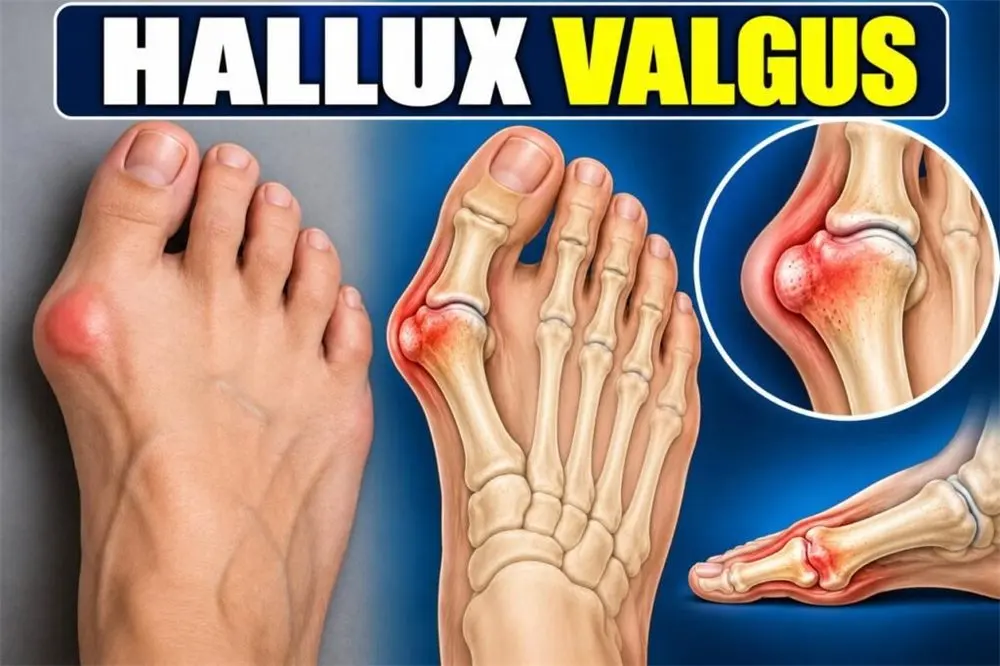
Hallux valgus, or a bunion, is when the big toe angles towards the other toes and a bony bump forms at its base. It can cause pain, rubbing and difficulty with shoes. Wider footwear, toe spacers, joint mobilisation and foot strengthening relieve symptoms; surgery is considered for severe, painful deformity.
How bunions develop
Bunions run in families and are more common in women. Narrow, pointed or high-heeled shoes push the big toe inward over time. Flat feet, loose ligaments and some forms of arthritis also contribute. The bump is mainly the end of the first metatarsal bone pushing outward, sometimes with swelling of the overlying bursa.
Symptoms
- A visible bump at the base of the big toe
- Pain, redness or rubbing from shoes
- Big toe crowding or overlapping the second toe
- Pain under the ball of the foot
- Stiffness of the big toe joint
Non-surgical care
- Footwear – wide, deep toe box and low heels
- Toe spacers or bunion pads to reduce rubbing
- Joint mobilisation for a stiff big toe joint
- Foot strengthening – toe spreading, short foot exercise, big-toe press
- Calf stretching and gait advice
- Ice or laser for painful flares
Exercise and spacers do not straighten a bunion, but many people become comfortable enough to avoid surgery.
When surgery is discussed
If pain persists despite good conservative care, or the deformity is severe, an orthopaedic foot surgeon may recommend correction. We provide rehabilitation afterwards.
Hallux Valgus: questions patients ask us
Can a bunion be corrected without surgery?
The bony shape will not reverse, but pain and function usually improve with footwear changes and exercise.
Do bunion correctors work?
Splints and spacers can ease discomfort but do not permanently straighten the toe.
What shoes should I wear with bunions?
Shoes with a wide, deep toe box, soft upper and low heel.
Are bunions hereditary?
Yes, they often run in families.
When should I see a surgeon?
If pain persists despite good non-surgical care, or the deformity is worsening rapidly.
Reviewed by Dr. Varun Duggal – Chiropractor, Osteopath and Physiotherapist (MPT Ortho), Kirti Nagar, New Delhi.
Last updated: