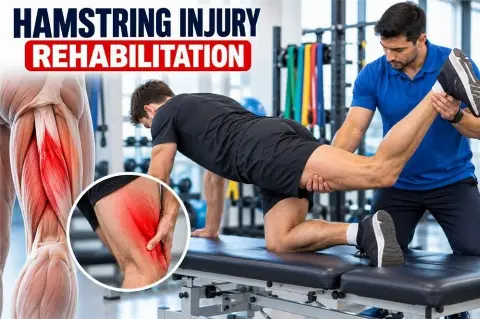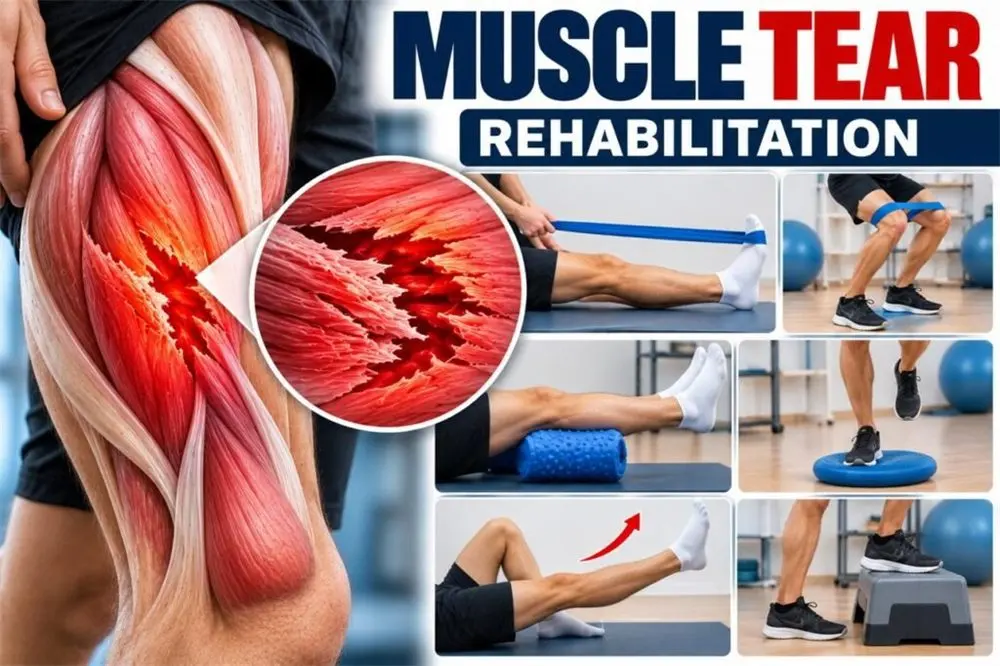
A muscle tear is a more severe strain where a significant number of fibres – or the whole muscle – are torn. It causes sudden pain, bruising, swelling and weakness. Partial tears usually heal with structured rehabilitation; complete tears or tendon detachments may need surgery. Careful, progressive loading helps the muscle heal strong and flexible.
Strain vs tear
The terms overlap. Doctors often describe a mild strain as Grade 1, a partial tear as Grade 2 and a complete tear as Grade 3. This page focuses on Grade 2 and 3 injuries, which need a more structured recovery.
Signs of a significant tear
- A pop or tearing sensation
- Immediate significant pain and loss of function
- Marked bruising and swelling
- A visible gap or bulge in the muscle
- Considerable weakness
Suspected complete tears or tendon ruptures – especially of the biceps, pectoral, quadriceps, hamstring tendon or Achilles – should be assessed by a doctor quickly, as early surgery may be needed.
Rehabilitation stages
- Protection (days 1–5): relative rest, compression, elevation, pain-free movement.
- Early loading: isometric contractions and gentle range of motion.
- Progressive strengthening: through increasing range and resistance.
- Function: running, jumping, lifting or sport-specific movements.
- Return: strength testing compared with the other side.
Scar tissue management
Torn muscle heals partly with scar tissue. Soft-tissue therapy and progressive loading help this scar become flexible and well-organised, reducing the risk of re-injury.
Muscle Tear Rehabilitation: questions patients ask us
How long does a muscle tear take to heal?
Partial tears often take four to twelve weeks; complete tears longer, sometimes with surgery.
Does a torn muscle need surgery?
Most partial tears do not. Complete tears and tendon detachments may.
Can I walk with a thigh muscle tear?
Usually yes, carefully, depending on severity and pain.
Why does rehab focus on strength testing?
Returning before strength is restored is a major cause of re-injury.
Will scar tissue limit me?
With proper rehab, scar tissue usually becomes flexible and strong enough for full activity.
Reviewed by Dr. Varun Duggal – Chiropractor, Osteopath and Physiotherapist (MPT Ortho), Kirti Nagar, New Delhi.
Last updated: