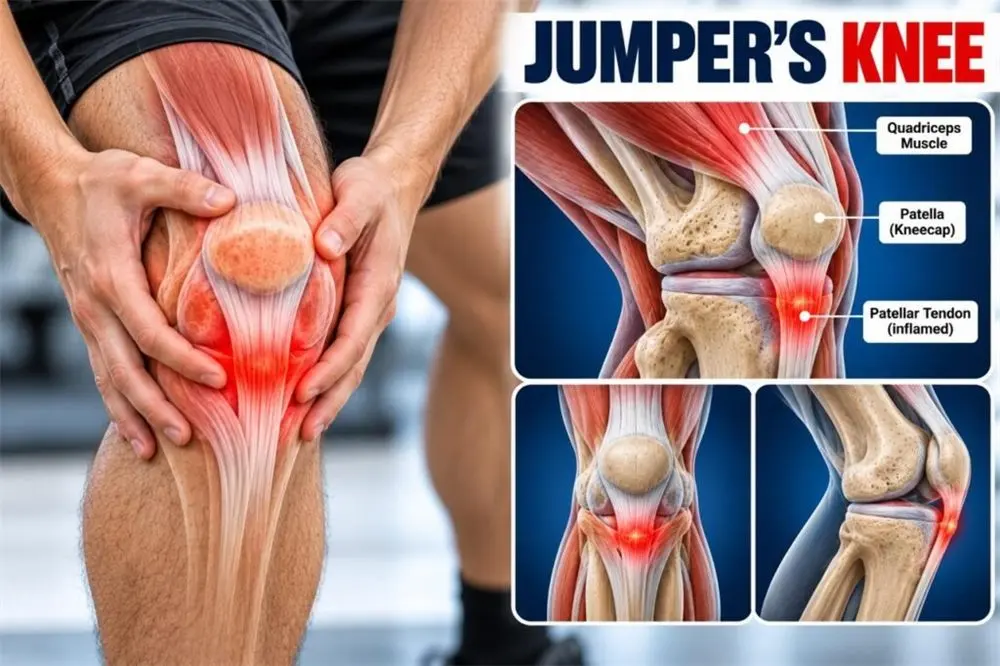
Jumper’s knee (patellar tendinopathy) is pain in the tendon just below the kneecap, caused by repeated jumping, landing and sprinting. Pain often warms up during activity and returns afterwards. A progressive tendon-loading programme is the main treatment, with shockwave therapy for stubborn cases.
Who gets it
Basketball, volleyball, badminton, football, kabaddi and high jump all put big repeated loads through the patellar tendon. Jumper’s knee is also seen in people who do lots of skipping, plyometric classes or stair running, especially after a sudden increase.
Typical symptoms
- Pain at the bottom of the kneecap
- Pain at the start of activity that may ease once warm, then worsen afterwards
- Pain jumping, landing, squatting and climbing stairs
- Stiffness the next morning
Why rest alone doesn’t fix it
Tendons adapt to load. Rest reduces pain but also leaves the tendon weaker, so pain returns when you go back to sport. Progressive loading builds the tendon’s capacity step by step.
The loading programme
- Isometrics – holding a wall sit or leg extension for 30–45 seconds, which often reduces pain.
- Heavy slow resistance – slow squats and leg presses, gradually heavier.
- Energy storage – skipping, hopping and jumping, gradually introduced.
- Sport-specific training – full jumping and cutting.
We support the programme with shockwave therapy for long-standing cases, soft-tissue work for the quadriceps and calves, and hip and ankle strengthening.
Timeline
Tendon rehab takes patience – often three months or more. The aim is a stronger tendon, not just a quieter one.
Jumper’s Knee: questions patients ask us
Can I keep playing with jumper’s knee?
Often yes, at reduced volume, if pain stays mild and settles by the next day.
Does a patellar strap help?
It can reduce pain during sport for some players, as a short-term aid.
Is shockwave effective for jumper’s knee?
It can help long-standing cases, combined with a loading programme.
Should I stretch my patellar tendon?
Stretching the quadriceps may help, but strengthening the tendon is the main treatment.
How long does jumper’s knee take to heal?
Usually three months or more of progressive loading.

Reviewed by Dr. Varun Duggal – Chiropractor, Osteopath and Physiotherapist (MPT Ortho), Kirti Nagar, New Delhi.
Last updated: