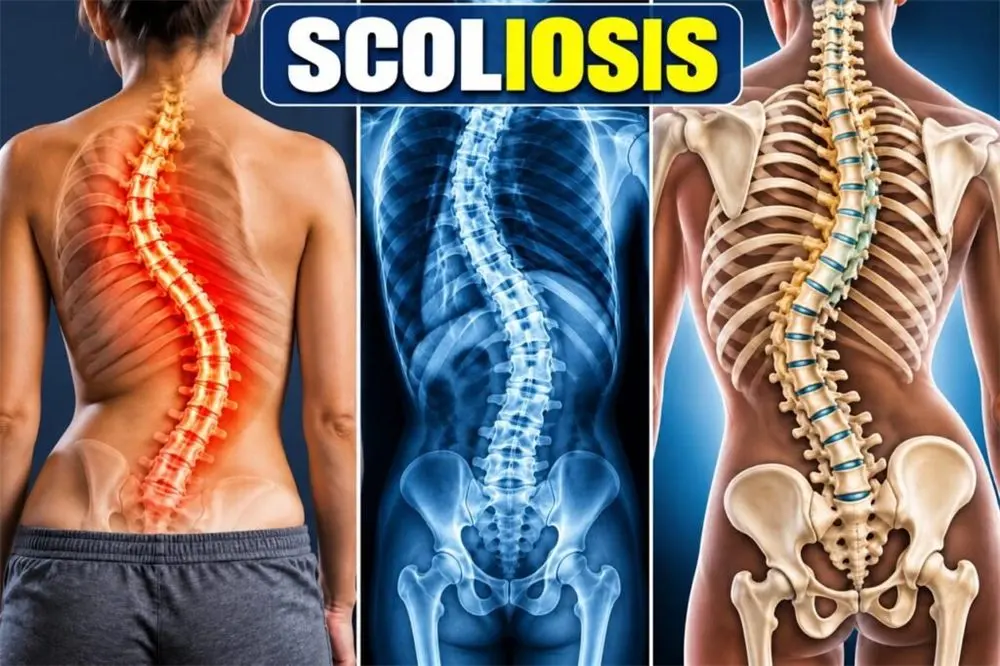
Scoliosis is a sideways curve of the spine, often with some rotation. Mild curves are common and may need only monitoring and exercise; larger curves in growing children may need bracing under a specialist. We provide scoliosis-specific exercise, gentle manual therapy and pain management for children and adults.
Types of scoliosis
- Idiopathic – the most common, usually appearing in adolescence with no known cause.
- Functional – a curve caused by something else, such as a leg-length difference or muscle spasm, which can resolve when the cause is treated.
- Degenerative – developing in adults as discs and joints wear unevenly.
- Congenital or neuromuscular – related to spinal development or conditions such as cerebral palsy.
Signs parents can look for
- One shoulder higher than the other
- One shoulder blade sticking out more
- Uneven waist creases or hips
- A rib hump when the child bends forward to touch their toes
What we offer
We measure posture and flexibility, review X-rays (the Cobb angle measures curve size) and coordinate with your orthopaedic specialist when needed. Our care focuses on:
- Scoliosis-specific exercises that work on breathing, elongation and posture control in three dimensions
- Gentle mobilisation of stiff areas of the spine and ribs
- Soft-tissue work to ease muscle tension on the tighter side
- Core and back strengthening for endurance
- Pain management for adults with degenerative curves
What exercise can and cannot do
Exercise improves posture, strength, flexibility and pain. In growing children with mild to moderate curves, it may help slow progression alongside monitoring. It is not a replacement for bracing when a specialist recommends it, and large progressive curves may need surgical opinion. We will always be clear about which group you or your child falls into.
Scoliosis: questions patients ask us
Can scoliosis be cured without surgery?
Most mild and moderate curves are managed without surgery. The aim is to control progression, improve posture and reduce pain rather than make the spine perfectly straight.
Is chiropractic safe for scoliosis?
Gentle techniques can ease stiffness and pain. They are combined with scoliosis-specific exercise and do not replace specialist monitoring.
At what age is scoliosis usually found?
Idiopathic scoliosis is most often noticed between 10 and 15 years of age, during growth spurts.
Can heavy school bags cause scoliosis?
They do not cause structural scoliosis, but they can worsen posture and back pain. Use both straps and keep the bag light.
Does scoliosis get worse in adults?
Some curves progress slowly with age. Regular exercise helps maintain function and reduce pain.
Reviewed by Dr. Varun Duggal – Chiropractor, Osteopath and Physiotherapist (MPT Ortho), Kirti Nagar, New Delhi.
Last updated: