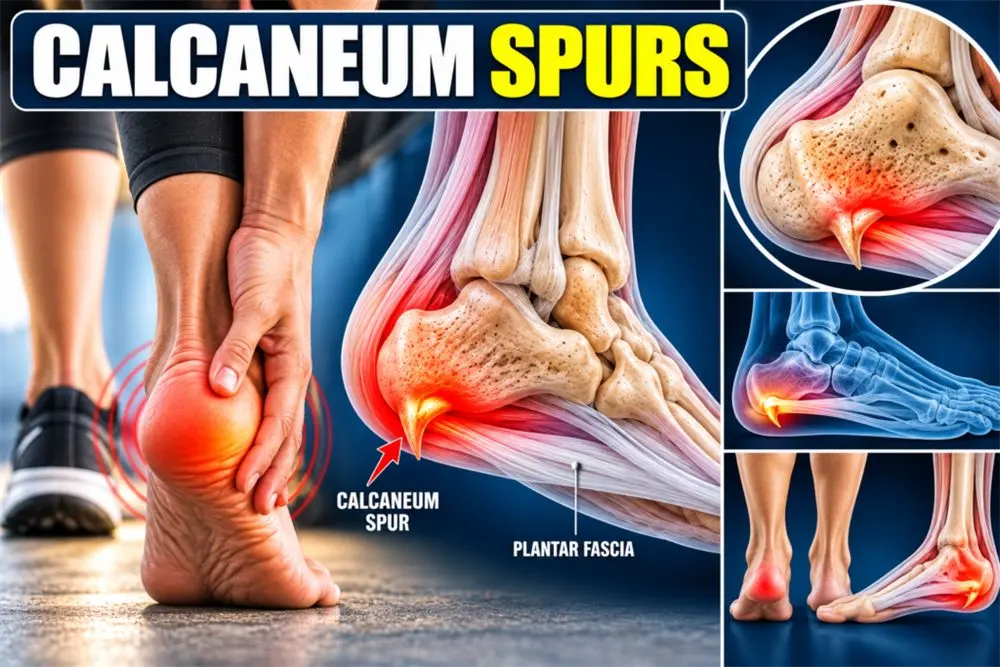
A calcaneal spur is a small bony growth on the heel bone, usually found on X-ray in people with long-standing plantar fasciitis. The spur itself is often painless; pain comes from the irritated tissue around it. Shockwave therapy, stretching, strengthening and footwear changes relieve most people without surgery.
Understanding heel spurs
When the plantar fascia and foot muscles pull on the heel bone repeatedly over months or years, the bone may respond by forming a small hook or shelf of new bone – the spur. Studies show many people have heel spurs without any pain. So seeing a spur on an X-ray does not mean it must be removed.
Symptoms
- Sharp heel pain on first standing in the morning
- Aching after long standing or walking
- Tender spot under the heel
- Sometimes pain at the back of the heel if the spur is at the Achilles attachment
Non-surgical treatment
- Shockwave therapy – strong evidence for heel pain with or without spurs
- Cushioned heel cup or silicone insole
- Calf and plantar fascia stretching
- Foot and calf strengthening
- Taping to offload the heel
- Laser therapy for pain relief
- Weight and activity advice
Is surgery needed?
Very rarely. Removing the spur does not always remove the pain, because the problem lies mainly in the soft tissue. Surgery is considered only after many months of failed conservative treatment.
Calcaneum Spurs: questions patients ask us
Do heel spurs need to be removed?
Rarely. Most heel spur pain improves without surgery.
Can shockwave break a heel spur?
Shockwave does not usually remove the spur, but it reduces pain by stimulating healing in surrounding tissue.
What shoes are best for heel spurs?
Shoes with a cushioned heel, good arch support and a slightly raised heel.
Can a heel spur go away?
The bone usually stays, but pain often goes away completely with treatment.
Are heel spurs and plantar fasciitis the same?
They are related. Spurs often develop with long-standing plantar fasciitis, which is usually the real pain source.
Reviewed by Dr. Varun Duggal – Chiropractor, Osteopath and Physiotherapist (MPT Ortho), Kirti Nagar, New Delhi.
Last updated: