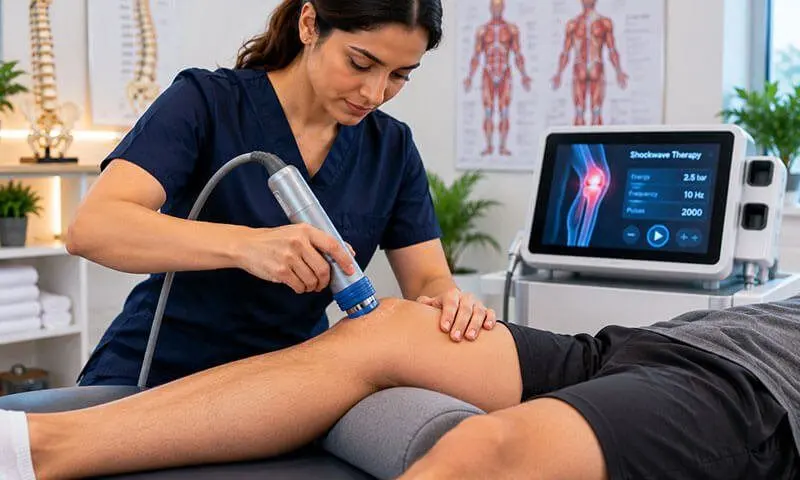
Shockwave therapy (ESWT) sends strong acoustic pulses into a painful tendon or fascia to stimulate the body’s healing response. It is mainly used for long-standing heel pain, tennis elbow, Achilles and patellar tendon pain, and calcific shoulder tendinitis that have not improved with other treatment.
Who shockwave therapy is for
Shockwave is not a first-line treatment for a fresh injury. It is most useful when a tendon or the plantar fascia has been painful for several months and has not responded well to rest, exercise and simpler therapies. In these “stuck” cases, it can help restart the healing process.
Conditions it is commonly used for
- Plantar fasciitis and heel spur pain
- Tennis elbow and golfer’s elbow
- Achilles tendinopathy
- Patellar tendinopathy (jumper’s knee)
- Calcific tendinitis of the shoulder
- Greater trochanteric (outer hip) pain
What happens during treatment
We locate the most tender spot, apply gel and use a hand-held applicator that delivers rapid pulses for a few minutes. It can feel uncomfortable – like strong tapping – but intensity is adjusted to what you can tolerate, and it usually becomes easier as the session goes on. Treatment typically takes 5 to 10 minutes and is repeated once a week for three to five sessions.
After a session
Some redness and soreness for a day or two is normal. We advise avoiding very heavy loading of the area for 48 hours, but gentle activity is fine. Painkillers of the anti-inflammatory type are best avoided around sessions unless your doctor advises otherwise, as they may dampen the healing response.
Combining with exercise
Tendons recover best when they are gradually loaded. Shockwave is therefore always combined with a progressive strengthening plan – for example calf raises for Achilles pain or wrist exercises for tennis elbow. This combination tends to give better results than either alone.
When it is not suitable
- Pregnancy
- Blood clotting disorders or blood-thinning medication
- Over growth plates in children
- Over a tumour, infection or recent steroid injection site
Why shockwave helps stubborn tendons
Long-standing tendon problems often get “stuck” in a state where healing has stalled. The acoustic pulses from shockwave therapy create a controlled stimulus in the tissue, which is thought to increase local blood flow, reduce pain sensitivity and restart the repair process. That is why it is used for problems that have lasted months, not days.
Realistic expectations
Improvement usually builds over several weeks after the last session, so patience is important. Combining shockwave with a home strengthening programme gives the best chance of lasting relief.
Shockwave Therapy: questions patients ask us
Is shockwave therapy painful?
It can be uncomfortable for a few minutes. We adjust the intensity to your tolerance, and it usually feels easier as the session continues.
How many shockwave sessions will I need?
Most people need three to five sessions, about a week apart.
When will I feel results?
Some feel improvement within weeks; for others it builds over two to three months as the tissue heals.
Can shockwave remove a heel spur?
It does not remove the bone spur, but it can reduce the pain from the surrounding tissue, which is usually the real source of symptoms.
Can I walk normally after a session?
Yes. You can walk and do daily activities straight away, but avoid intense sport for a couple of days.
Reviewed by Dr. Varun Duggal – Chiropractor, Osteopath and Physiotherapist (MPT Ortho), Kirti Nagar, New Delhi.
Last updated: