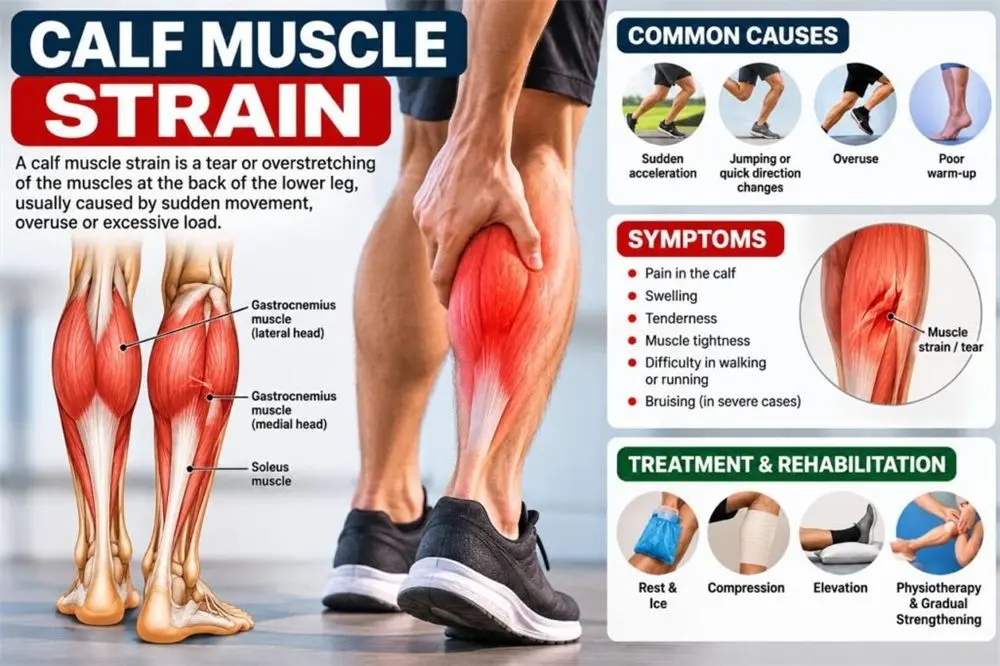
A calf strain is a tear in the muscle fibres at the back of the lower leg, often felt as a sudden sharp pain or a “kick” while running or pushing off. Most heal well with early guided movement, soft-tissue work and progressive calf strengthening before returning to sport.
How it happens
Calf strains commonly happen when pushing off quickly – sprinting, jumping, playing badminton or tennis – especially in players over 35. Some people describe feeling as if someone kicked or hit them in the back of the leg.
Grades of strain
- Grade 1: mild tightness and pain; walking is possible
- Grade 2: clear pain, swelling, bruising and limping
- Grade 3: complete tear; severe pain, difficulty standing on toes
Calf pain with swelling, warmth and redness without an injury – especially after a long journey, surgery or illness – may be a blood clot (DVT). Seek medical attention urgently. A sudden snap at the heel may be an Achilles rupture.
Rehabilitation
- First days: relative rest, compression, elevation, gentle ankle movement.
- Early phase: walking within comfort, gentle calf stretching, soft-tissue work.
- Strength phase: double then single-leg calf raises, bent-knee raises, progressive loading.
- Power phase: skipping, hopping, jogging and sprints.
- Return to sport: sport-specific drills and strength testing.
Recovery time
Mild strains often recover in two to three weeks; moderate strains in four to eight weeks. Returning too early is the most common reason for recurrence, so we use strength tests to guide the decision.
Calf Muscle Strain: questions patients ask us
Should I stretch a pulled calf?
Gentle stretching after the first few days is helpful. Avoid aggressive stretching early on.
How long does a calf strain take to heal?
From about two weeks for mild strains to two months for more severe ones.
Can I walk with a calf strain?
Usually yes, within comfort. A small heel raise in the shoe can help early on.
How do I prevent calf strains?
Regular calf strengthening, good warm-ups and gradual training increases.
Is calf pain always a muscle strain?
No. Swelling and redness without injury can indicate a blood clot and needs urgent medical care.

Reviewed by Dr. Varun Duggal – Chiropractor, Osteopath and Physiotherapist (MPT Ortho), Kirti Nagar, New Delhi.
Last updated: