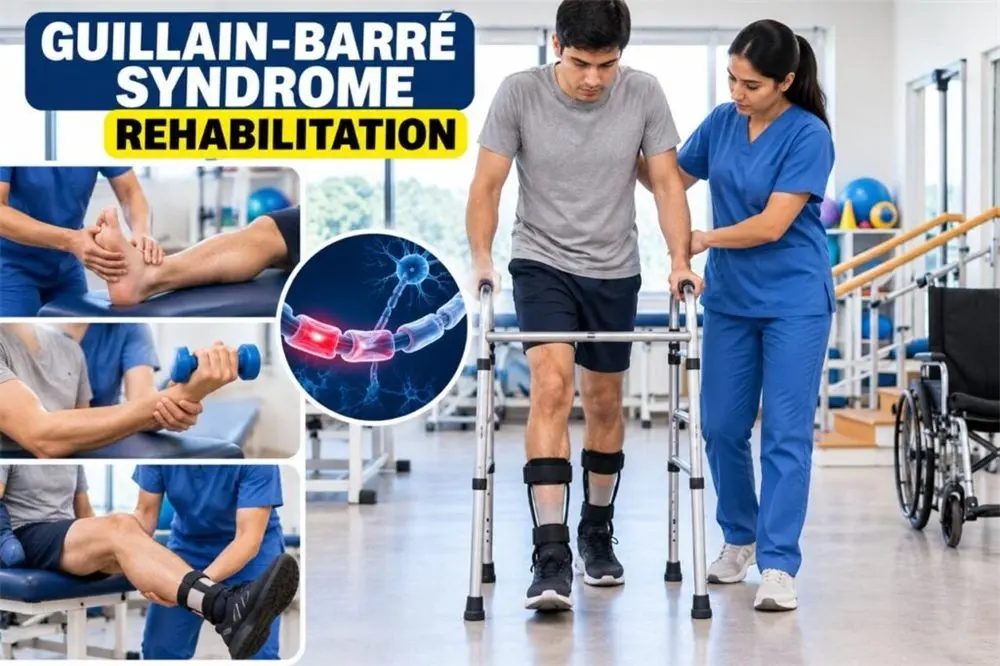
Guillain-Barré syndrome (GBS) is a rare condition in which the immune system attacks the peripheral nerves, causing rapidly spreading weakness. After hospital treatment, most people recover significantly, but it can take months. Physiotherapy guides a gradual, fatigue-aware return of strength, balance and walking.
Understanding GBS
GBS often follows an infection, such as a stomach bug or respiratory illness. Weakness and tingling usually start in the feet and spread upwards over days. Some people become unable to walk or need help breathing. Hospital treatment (immunoglobulin or plasma exchange) stops the immune attack, and then the nerves begin to heal.
Rapidly spreading weakness, difficulty breathing or swallowing needs emergency hospital care.
Rehabilitation stages
In and soon after hospital
Positioning, gentle range-of-motion exercises, chest physiotherapy and preventing pressure sores and stiffness.
Recovery phase
As nerves heal, strength returns – usually from the top down. We gradually progress from bed exercises to sitting, standing, walking with aids and finally independent walking.
Return to life
Endurance, stairs, community walking, and return to work or study.
Avoiding over-fatigue
Healing nerves are sensitive to overwork. Pushing too hard can cause prolonged fatigue and setbacks. We use short, frequent sessions, monitor fatigue closely and increase activity in small steps.
What to expect
Most people with GBS make a good recovery, though some have lasting weakness, fatigue or numbness. Recovery can take from a few months to a year or more.
Guillain-Barré Syndrome: questions patients ask us
Can people fully recover from GBS?
Many make a full or near-full recovery, though some have lasting weakness or fatigue.
How long does GBS rehab take?
From a few months to over a year, depending on severity.
Why is fatigue such a problem in GBS?
Healing nerves tire easily; over-exertion can slow recovery. We pace exercise carefully.
When should physiotherapy start?
In hospital, as soon as it is safe, then continuing at home or in the clinic.
Reviewed by Dr. Varun Duggal – Chiropractor, Osteopath and Physiotherapist (MPT Ortho), Kirti Nagar, New Delhi.
Last updated: