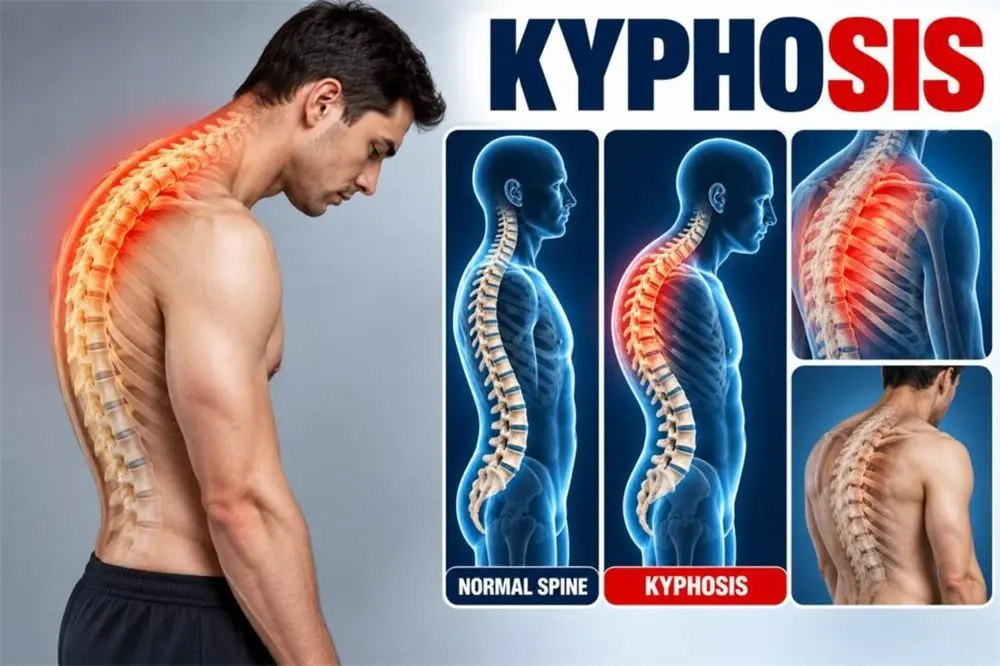
Kyphosis is an excessive forward rounding of the upper back. The most common type, postural kyphosis, comes from slouching and weak back muscles and responds well to treatment. Structural types need specialist monitoring. We combine thoracic mobilisation, strengthening and daily posture training.
Types of kyphosis
Postural kyphosis
The most common form, seen in teenagers and office workers. The curve is flexible – you can straighten it when you try – and it is caused by habits and muscle imbalance. This type responds very well to exercise.
Scheuermann’s kyphosis
A structural type that develops during growth when vertebrae become wedge-shaped. The curve is stiffer and may need monitoring by a spine specialist alongside exercise.
Age-related kyphosis
In older adults, disc wear and sometimes osteoporotic compression fractures can increase the curve. Bone health assessment is important.
Symptoms
- Visible rounding of the upper back and forward head position
- Upper back and neck ache, tiredness after standing
- Tight chest muscles and limited overhead arm movement
- In severe cases, reduced breathing capacity
How we help
- Thoracic mobilisation and gentle adjustments to improve upper-back extension
- Stretching of chest, shoulder and hip-flexor muscles
- Strengthening of upper-back extensors and the muscles between the shoulder blades
- Posture retraining for sitting, standing, phone use and study
- Breathing exercises to open the rib cage
For older adults, all techniques are adapted for bone density. If a sudden increase in the curve or sharp back pain suggests a fracture, we refer for imaging first.
Expected results
Postural kyphosis often shows visible improvement within two to three months of consistent work. Structural curves may change less in shape, but pain, flexibility and posture endurance usually improve.
Kyphosis: questions patients ask us
Can kyphosis be corrected?
Postural kyphosis can usually be corrected well with exercise. Structural kyphosis improves less in shape but often becomes less painful.
Do posture braces fix kyphosis?
Braces are used for some growing children with structural kyphosis under specialist advice. For postural kyphosis, exercise works better.
What causes kyphosis in teenagers?
Usually slouching, heavy school bags and long screen time. Scheuermann’s disease is a less common structural cause.
Is kyphosis in older people a sign of osteoporosis?
It can be. A bone density test is sensible if the curve is increasing or there has been height loss.
How long before posture improves?
Most people notice better posture and less pain within 8 to 12 weeks of regular exercise.

Reviewed by Dr. Varun Duggal – Chiropractor, Osteopath and Physiotherapist (MPT Ortho), Kirti Nagar, New Delhi.
Last updated: