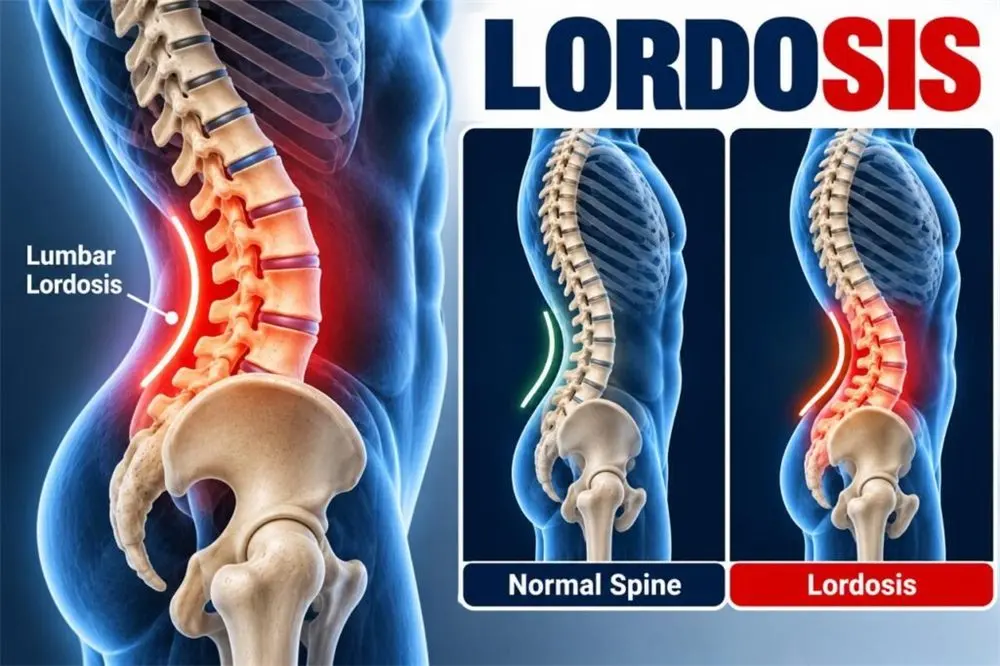
Lordosis is the natural inward curve of the lower back and neck. When the lower back curve becomes excessive (hyperlordosis), it can load the facet joints and cause aching. Tight hip flexors and weak abdominal and glute muscles are common causes. Stretching, core work and joint mobilisation usually help.
When a normal curve becomes too much
A healthy spine has gentle curves that act like springs. In hyperlordosis, the pelvis tips forward and the lower back arches excessively. You might notice your bottom sticking out and your stomach pushing forward, even if you are not overweight.
Common contributors
- Long sitting, which tightens the hip flexors
- Weak deep abdominal and gluteal muscles
- Pregnancy and carrying extra weight at the front
- High heels worn for long periods
- Sports with repeated arching – gymnastics, dance, bowling
Symptoms
- Lower back ache after standing or walking
- Tightness at the front of the hips
- Back pain when lying flat on the back with legs straight
- Relief when sitting or curling up
Our approach
We assess pelvic position, hip flexibility and core control. Treatment typically includes:
- Mobilisation of stiff lumbar and hip joints
- Stretching the hip flexors and lower back muscles
- Activating the deep abdominal muscles and strengthening the glutes
- Learning a comfortable “neutral” pelvic position for standing and lifting
- Workstation and footwear advice
Less commonly, an exaggerated curve is linked to a spinal condition such as spondylolisthesis (a forward slip of a vertebra). If we suspect this, we recommend imaging before manual treatment.
Lordosis: questions patients ask us
Is lordosis bad?
A natural lordosis is healthy. Problems arise when the curve becomes excessive and causes pain or stiffness.
Can lordosis be corrected with exercise?
Postural hyperlordosis usually improves well with stretching and core and glute strengthening.
Does sitting all day cause lordosis?
Long sitting tightens the hip flexors, which can pull the pelvis forward and increase the curve when you stand.
Can lordosis cause back pain?
Yes, by increasing load on the facet joints and lower back muscles.
Should I stop wearing heels?
Reducing time in high heels can help. Save them for shorter periods if you have lower back pain.
Reviewed by Dr. Varun Duggal – Chiropractor, Osteopath and Physiotherapist (MPT Ortho), Kirti Nagar, New Delhi.
Last updated: