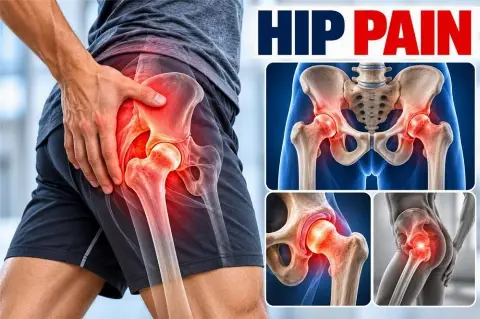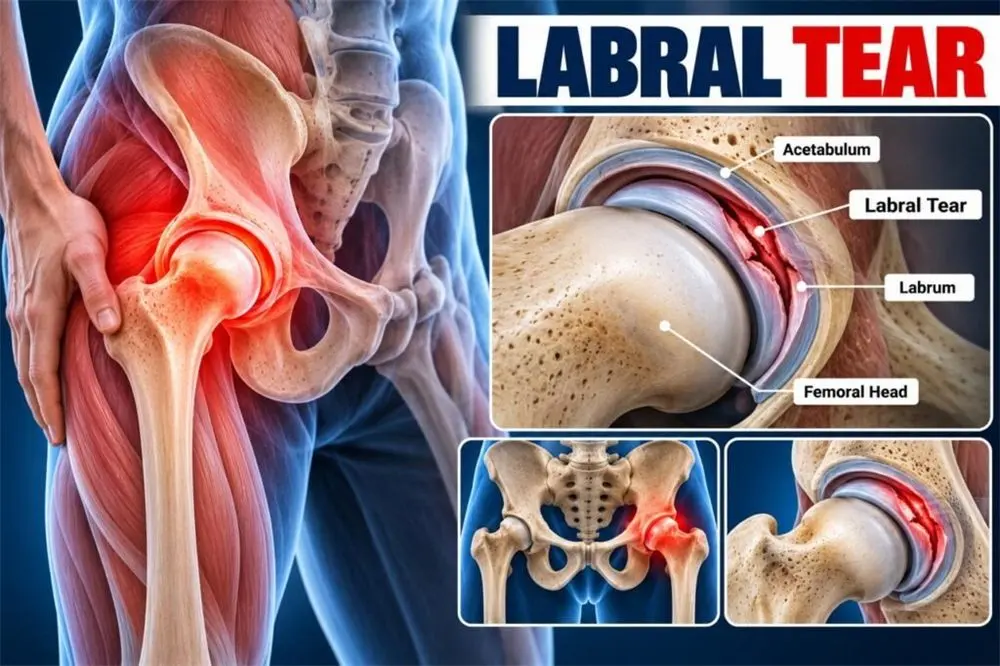
The labrum is a ring of cartilage around the hip socket that deepens and seals the joint. Tears cause groin pain, clicking, catching and stiffness, especially with deep bending and twisting. Many people improve with movement modification and progressive hip and core strengthening; others need arthroscopy followed by rehab.
What the labrum does
The hip labrum works like a rubber seal around the rim of the socket. It improves stability and helps keep joint fluid in place. It can tear from a single injury, from repeated deep flexion and twisting in sport, or from the shape of the hip bones rubbing (femoroacetabular impingement, FAI).
Symptoms
- Deep groin or front-of-hip pain
- Clicking, catching or locking
- Pain with sitting low, getting out of a car, or deep squats
- Stiffness and reduced hip rotation
Similar symptoms can come from groin strains, hernias or the lower back, so careful assessment matters. An MRI arthrogram may be needed to confirm a tear.
Conservative rehabilitation
- Calm the joint – avoid deep flexion, pivoting and prolonged low sitting for a while.
- Restore movement – gentle hip and lower back mobilisation within pain-free limits.
- Strengthen – glutes, deep hip rotators and core to stabilise the joint.
- Retrain movement – squat, lunge, running and sport mechanics.
- Return to activity gradually with clear milestones.
After arthroscopic surgery
If a surgeon repairs the labrum or reshapes the bone, a structured rehab programme is essential. We follow the surgeon’s protocol, progressing from protected walking to strength and sport-specific training over three to six months.
Labral Tear: questions patients ask us
Can a hip labral tear heal without surgery?
The tear may not heal fully, but many people become pain-free and active with rehabilitation.
What activities should I avoid?
Deep squats, sitting low, pivoting and extreme hip rotation while symptoms settle.
How is a labral tear diagnosed?
Through clinical tests and usually an MRI arthrogram.
How long is rehab after hip arthroscopy?
Typically three to six months, depending on the procedure and your sport.
Is cycling okay with a labral tear?
Often yes, with the seat raised to avoid deep hip bending.
Reviewed by Dr. Varun Duggal – Chiropractor, Osteopath and Physiotherapist (MPT Ortho), Kirti Nagar, New Delhi.
Last updated: